Works with Clio Manage

Defensible KYC decisions for Clio legal firms

Clio helps legal professionals manage clients, matters, documents, and workflows. JUSTE adds the AML decision-governance layer: start screening from a Clio contact, let your firm’s AML policy automatically govern the outcome, and receive the completed risk screening or inspection report back in the Clio matter record in just two minutes.

Most AML tools show what the screening found. JUSTE shows how the final decision was governed, evidenced, and reached.

AI executes · Policy governs · Humans supervise · Evidence survives

See it govern a real client

Start from a contact you already manage in Clio. No platform swap, no rekeying.

The defence layer

One decision record. Four exposure lines evidenced.

Every JUSTE decision is recorded as an evidenced, policy-governed chain — the proof regulators and senior managers increasingly expect across overlapping frameworks.

AML/AMLREU/UK AML Regulation — screening, KYC/KYB, record-keeping
GDPRLawful, minimised data handling with an audit trail
EU AI ActTransparency & human oversight, proven not just claimed
CPA s.250UK senior-manager liability — controls that follow the work

From 29 June 2026, UK Crime and Policing Act Section 250 can expose bodies corporate and partnerships where a senior manager commits an offence while acting within actual or apparent authority. When liability follows delegation, controls must follow the work.

How it works with Clio

Clio stays the system of record. JUSTE governs the AML decision.

Screening starts and ends where you already manage the client and matter. JUSTE adds the specialist AML and governed-decision layer on top.

Start from a Clio contact

Select or create a contact, then launch KYC with SCREEN. The contact's data flows in — no rekeying.

JUSTE screens & classifies

Sanctions, PEP, adverse media, sector and territorial risk run, and the outcome is classified against your policy.

Policy governs the outcome

AI recommends; your firm's risk policy decides. Any override is recorded with the rule, reason and version.

Report returns to Clio

The risk or inspection report lands in the matter documents, and stays available in JUSTE for review and storage.

For a low-risk client, adding an ID document to the screening result is a complete, inspection-ready record. Most of your book clears here.

See it in action

Watch the integration run end to end.

The steps above in 90 seconds: start from a Clio contact, JUSTE screens and governs against your policy, and the report lands back in the matter. No platform swap, no rekeying.

Key benefits

What your firm gets inside Clio.

Start screening from a contact

Launch AML screening straight from a Clio contact or matter, pre-filled from data you already hold. No platform swap, no rekeying.

Reports back in the matter

Completed risk screening and inspection reports return automatically to the Clio matter documents — and stay available in JUSTE for supervision and storage.

Audit-ready by default

Each decision is captured as it happens — screening, policy, override, human action — so the matter file is inspection-ready without extra work.

Partner-level defence

See what happens at intake — without relying on memory or manual supervision.

When liability follows delegation, controls have to follow the work. JUSTE gives senior partners visibility into every intake decision, and gives the team clear, codified pathways to follow.

If a shortcut is ever taken at intake, the record shows it as an isolated, attributable exception — not evidence of a weak compliance culture across the firm.

AI recommended · policy required · override applied · who approved — captured on every decision.
JUSTE risk assessment showing AI recommendation overridden by the firm's risk policy, with the override recorded
Proof where the firm needs it

Not just a screening result. The operating history of the decision outcome.

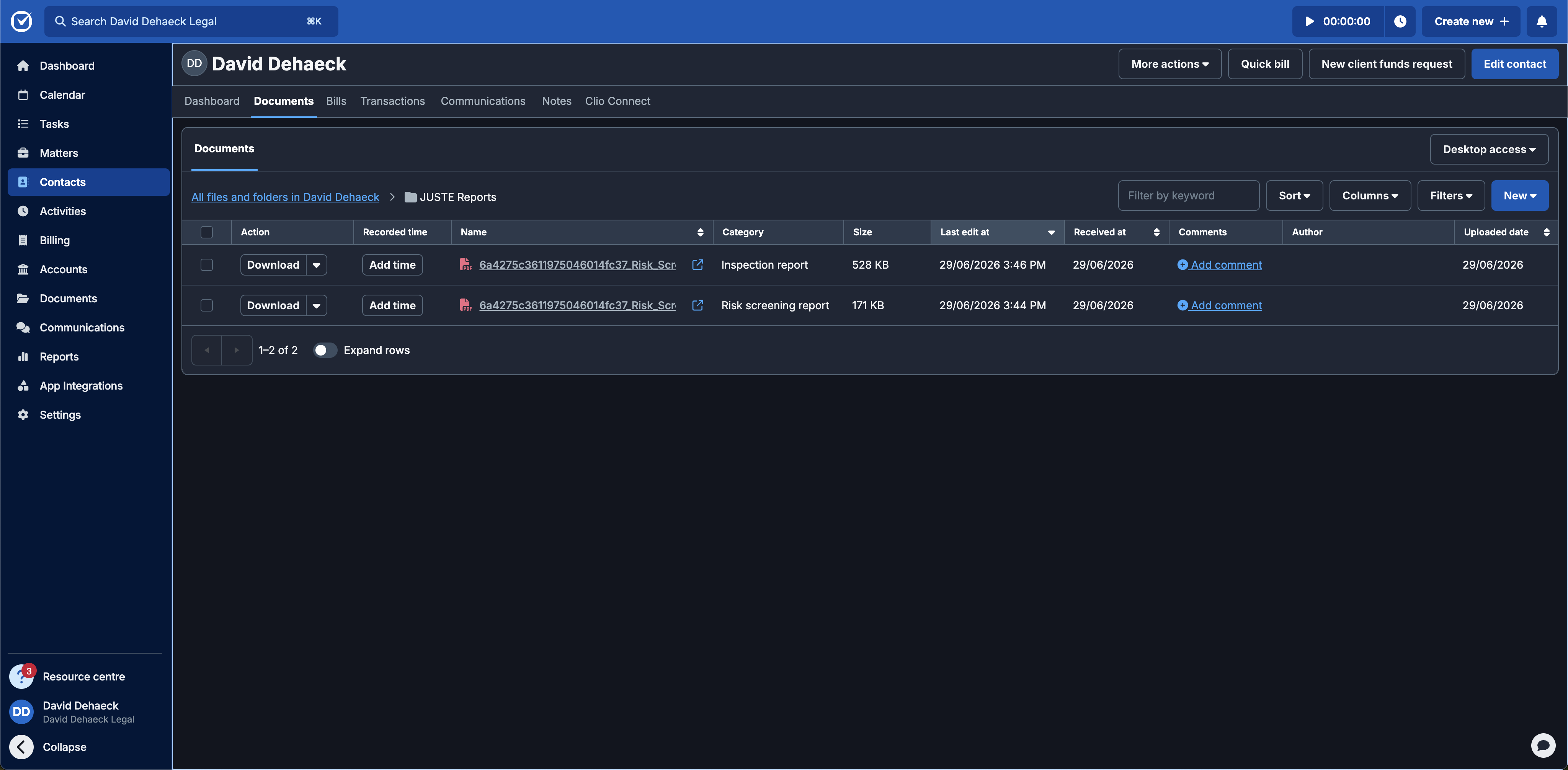
Completed risk screening and inspection reports return automatically to the relevant Clio contact or matter documents, while remaining available inside JUSTE for download, review, supervision, and long-term storage.

A Clio contact record showing the JUSTE risk screening report and inspection report returned to the matter documents

Inside Clio: the contact's risk screening report and inspection report, returned to the matter documents and kept in sync with JUSTE — where the governed AML record is supervised and stored.

Enhanced risk

When enhanced risk appears, the deeper work happens in JUSTE.

Low-risk clients usually proceed with simplified due diligence. When JUSTE detects medium- or high-risk indicators, the workflow moves into proportionate CDD or EDD — collecting the right evidence, asking targeted questions, capturing human review, and preserving the decision history before the final report returns to Clio.

1 · Medium risk

CDD for medium-risk profiles

JUSTE guides the user through additional checks and evidence requests linked to the specific risk drivers found during screening.

2 · High risk

EDD for high-risk profiles

JUSTE generates enhanced due diligence questions, tracks supporting evidence, and escalates the case for review where the firm's policy requires it.

3 · Outcome

Human review and final outcome

The system records who reviewed the case, what policy applied, what evidence supported the decision, and why the client was approved, escalated or declined.

For now, CDD and EDD are completed inside the firm's JUSTE account. Clio remains the matter system of record, and the final status, report and audit reference can be returned to Clio.
How is JUSTE different?

Not another screening tool with a compliance UI.

Most AML apps run a check and hand back a result. JUSTE makes your firm's own policy the engine, screens for risk before paperwork, and records how every decision was reached.

01

Your risk policy is the engine

Your firm's AML policy becomes executable logic that governs every classification at the point of decision — and overrides the AI wherever your rules require it. Defensibly determined, not subjectively interpreted.

Others apply a generic ruleset. JUSTE runs on yours.
02

Screening-first, not ID-first

JUSTE leads with a defensible view of risk before any document collection, so effort is proportionate to what screening actually surfaced — not a checklist by default.

Others start with ID capture. JUSTE starts with risk.
03

Governed decisions, not just results

Every outcome is captured as an evidenced chain — what was screened, what the AI found, what policy required, where it overrode, and who approved.

Others show what the screening found. JUSTE shows how it was governed.
04

It builds the policy too

Don't have a robust risk policy yet? JUSTE creates a personalised ML/TF risk assessment and AML/CTF policy from your firm's services, clients and geographies — ACAMS-reviewed, then deployed as the engine that governs every screening.

Others assume you already have a policy. JUSTE writes one and runs it.
Endorsements

The difference, in their words.

JUSTE has been developed in demanding AML environments where screening, policy governance and evidence quality matter. Early users and supervisors highlight faster risk screening, easier access to risk assessments, and a governed AI approach.

"

I am impressed. It's a very good system. I just wish everyone used this — it would make life so much easier.

Senior UK AML Supervisor
"

Relying on a trustworthy partner for such complex matters as AML and KYC has been extremely valuable — saving us significant time and unnecessary stress with regard to our AML obligations, allowing us to remain focused on our core business.

Anne Vierstraete · Senior Advisor, Head of Alliances & Partnerships, Art Brussels & Art Antwerp
"

JUSTE offers a cost-effective solution for instant risk screening. Its risk-policy-driven, human-led AI approach is unique, and its sanctions screening and risk assessments are easy to access and use.

Dave van Moppes — Partner, Tuerlinckx Tax Lawyers
Recognition & programmes

Participation in the FCA Innovation Pathway does not constitute FCA authorisation or endorsement. Programme and award references are shown for context.

The product ladder

Choose the level that fits your AML burden.

JUSTE is a ladder, not a single product. Choose the tier that matches your AML burden today and step up a rung as your client base demands.

Base tier · from £300/yr

JUSTE SCREEN

From £2 per inspection report
Risk-screening first.

Screen any contact; for a low-risk profile, add an ID document and you have a compliant SDD inspection report. Most of your book lands here.

Best for: firms with a mostly low-risk book who need fast, defensible screening at intake. Pricing overview
Flagship · from £900/yr

JUSTE AML

Full policy-governed operating system
For firms that run AML as a team.

The complete agent workforce, policy governance with human approval, full decision provenance and audit-readiness across the firm.

Best for: regulated firms with an AML function — MLRO, supervision and team workflows. Pricing overview

Not sure which tier fits your firm? Most firms don't at first — it depends on your client base, headcount and risk profile. We'll scope it with you in a short demo.

Book a demo to scope it
FAQ

Questions firms ask before connecting.

How does JUSTE connect to Clio?
JUSTE works with Clio Manage. You start KYC from a Clio contact or matter, JUSTE uses that contact's data to run screening, and the completed report is returned to the Clio matter documents — no rekeying and no platform swap.
Which tier is right for my firm?
It depends on your client base, headcount and risk profile. Screening-first firms with a mostly low-risk book usually start on JUSTE SCREEN; firms with mixed or international clients that regularly hit medium/high risk need JUSTE KYC; firms running a dedicated AML function choose JUSTE AML. If you're unsure, a short demo is the fastest way to scope it.
What does a low-risk client need?
For a low-risk profile, adding an ID document to the screening result produces a complete, inspection-ready SDD record. Intake can come from existing Clio contact details or from the JUSTE mobile app, which can return a report in about four minutes.
How is the risk level decided?
AI recommends a risk level for each risk type, but your firm's own risk policy governs the final classification. Where policy and AI differ, the override is recorded with the rule reference, reason and version — a defensible, repeatable decision rather than a subjective one.
What happens for medium- or high-risk clients?
Medium- and high-risk profiles are routed into CDD or EDD inside JUSTE. The system guides evidence requests, targeted questions, policy-governed escalation and human review. Once completed, the final report and status can be returned to the Clio matter record.
Where are JUSTE reports stored?
Completed risk screening and inspection reports are returned automatically to the relevant Clio contact or matter documents. They also remain available inside JUSTE for download, review, supervision and long-term storage. The services run in sync, so the firm accesses the report in Clio while preserving the governed AML record in JUSTE.
Which JUSTE product is on the Clio directory?
The listed app is JUSTE KYC, which covers SDD, CDD and EDD on one workforce. JUSTE SCREEN sits below it for screening-first firms, and JUSTE AML above it as the full policy-governed operating system for firms running an AML team.

Ready to see the integration live?

We'll show you how JUSTE + Clio turns intake into a defensible, policy-governed AML record — in your own workflow.